By Daniel Whitmore
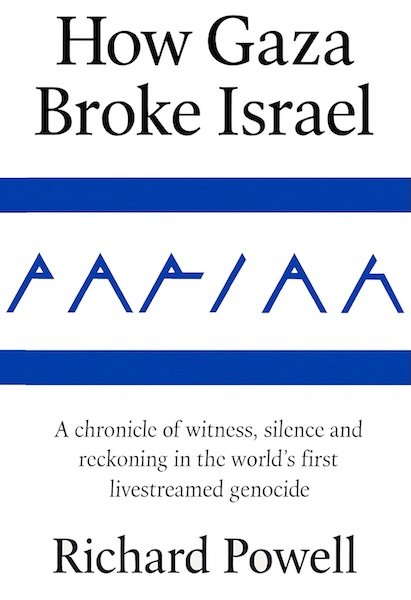
Military deterrence has long structured Israeli strategic doctrine. Richard Powell’s Pariah: How Gaza Broke Israel argues that the Gaza war revealed the limits of deterrence in a world shaped by digital transparency and legal scrutiny.
Powell’s thesis is not that Israel lost militarily. It is that traditional measures of success — degraded enemy capacity, restored short-term deterrence — no longer operate in isolation from reputational and diplomatic cost. In Gaza, the strategic equation expanded.
The book places October 2023 within a longer security paradigm. Since the early 2000s, Israeli policy toward Gaza has combined military containment with territorial disengagement. The objective was to manage risk without assuming long-term administrative responsibility. Powell contends that this approach produced a fragile equilibrium.
When large-scale violence erupted, that equilibrium collapsed. Powell examines how sustained aerial bombardment and ground operations unfolded under intense international observation. Civilian documentation and global media scrutiny compressed the distance between action and reaction.
The United States remains central to the strategic analysis. Powell reviews congressional funding decisions, executive statements and Security Council vetoes. He argues that while Washington maintained formal support, domestic political divisions deepened, particularly among younger constituencies and within academic institutions.
European allies are examined through a similar lens. Public demonstrations, parliamentary dissent and shifting party rhetoric are presented as indicators of recalibration. Powell does not predict alliance rupture. Instead, he suggests a gradual rebalancing shaped by reputational risk.
The Global South features prominently in the book’s geopolitical map. Powell notes that several governments across Africa, Latin America and Asia framed Gaza in terms of international accountability rather than strategic necessity. Voting patterns at the United Nations reflected this divergence.
Energy politics adds another layer. Eastern Mediterranean gas fields, maritime corridors and regional infrastructure projects intersect with broader Middle East strategy. Powell suggests that commercial and strategic considerations coexist with security calculations.
The book also engages with the question of long-term deterrence credibility. Powell argues that while overwhelming force may restore short-term tactical control, sustained humanitarian devastation can generate political backlash that complicates future deterrence calculations.
Legal proceedings amplify this recalibration. Once the International Court of Justice and International Criminal Court entered the diplomatic equation, reputational exposure became institutional. Judicial vocabulary now shadows strategic planning.
The prose remains analytical rather than polemical. Powell’s moral position is clear, but the geopolitical analysis is structured and layered. Israeli security concerns are acknowledged, particularly in relation to armed attacks from Gaza. However, Powell questions whether deterrence alone can secure legitimacy in an era of permanent documentation.
There are moments where the argument presses hard against complexity. Yet the coherence of the strategic thesis remains intact. Powell consistently links battlefield decisions to long-term diplomatic and legal consequence.
As a foreign-affairs style examination of Gaza’s broader strategic impact, Pariah offers a serious and sustained argument. It challenges readers to reconsider whether deterrence, as traditionally understood, remains sufficient in a networked world.
In Powell’s assessment, Gaza marked not the end of Israeli strategic power, but the beginning of its recalibration.
The book is published in ebook, paperback and hardback editions. Full retailer information, including Amazon links, is available at https://pariahbook.com/, where the opening three chapters may also be downloaded at no cost.