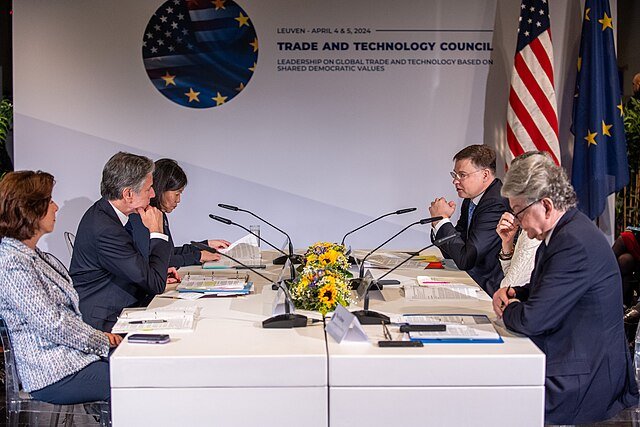
In a sleek conference room overlooking Paris’s bustling streets, negotiators from the United States and the European Union huddled on Wednesday, their briefcases stuffed with proposals to defuse a brewing trade war. The talks, held on the sidelines of an Organization for Economic Cooperation and Development (OECD) meeting, saw the EU’s top trade negotiator, Maroš Šefčovič, lock eyes with U.S. Trade Representative Jamieson Greer in a bid to avert crippling tariffs that could jolt both economies. With President Donald Trump’s threats of 50% duties looming, the stakes couldn’t be higher for these transatlantic giants.
The Paris meeting follows months of friction, sparked by Trump’s April decision to slap 25% tariffs on EU steel, aluminum, and cars, and a 10% levy on all EU imports, citing a $161 billion U.S. trade deficit in 2024. The EU, the world’s largest trading bloc, countered with a “zero for zero” deal, offering to scrap tariffs on industrial goods, including autos, if the U.S. reciprocates. Trump rejected the idea, but EU officials insist it remains on the table. “We’ve got a few weeks to find common ground,” French Trade Minister Laurent Saint-Martin said, his tone firm yet hopeful. The EU has dangled increased purchases of U.S. liquefied natural gas and defense equipment, plus lower car duties, but draws a line at scrapping its value-added tax or opening markets to American beef, banned due to hormone concerns.
“We’re moving forward at a good clip and keeping the lines open,” Šefčovič said at a press conference, his handshake with Greer a small gesture of optimism. Yet, both sides know a breakthrough in Paris is unlikely. The issues—tariffs, trade deficits, and regulatory differences—are thorny. Trump’s focus on the EU’s 10% car import tax, compared to the U.S.’s 2.5% before his hike, fuels his claim of unfair practices. The EU argues its massive purchases of U.S. tech services nearly erase the deficit. “If talks fail, we’re ready with countermeasures on American goods,” Saint-Martin warned, hinting at duties on U.S. whiskey or motorcycles.
The talks reflect broader economic pressures. The EU and U.S., with a €1.6 trillion trade relationship, are each other’s largest partners, supporting millions of jobs. The EU is a key buyer of U.S. energy, critical for countering Russia’s aggression in Ukraine, while the U.S. relies on EU pharmaceutical ingredients and machinery. But Trump’s tariffs, including a surprise 50% levy on EU steel last week, have rattled markets and industries like Stellantis, the Franco-Italian carmaker. “These tariffs hit our factories hard,” said Luca Rossi, a Turin auto worker. “We need a deal, not a trade war.” Greta Peisch, former U.S. trade counsel, suggested the zero-for-zero deal could work if Trump seeks a way to avoid further escalation, but she questioned his team’s motivation. “Do they really want a deal?” she mused.
The backdrop is tense. Past talks, like the 2013–2016 Transatlantic Trade and Investment Partnership, collapsed over issues like food safety standards—EU bans on chlorinated chicken and GMOs remain a sore point. Trump’s unpredictable style, tearing up deals like those with Canada and Mexico, makes the EU wary. “We’re negotiating by the book, but he’s rewriting it,” said a Brussels official, speaking anonymously. The EU’s recent push for free trade deals with other regions signals a hedge against U.S. volatility. A July 9 deadline, extended after a call between Trump and EU Commission President Ursula von der Leyen, adds urgency.
Reactions are mixed. In Paris, café owner Marie Dubois worried about rising costs. “If tariffs hit, my coffee and wine prices go up,” she said. Analysts like David Henig from the European Centre for International Political Economy see modest progress as the best hope, given Trump’s erratic team. “They don’t seem to know what they want,” he said.
The implications are vast. A deal could stabilize markets and jobs, but failure risks a tit-for-tat tariff spiral, hiking prices for consumers. The EU’s planned countermeasures could target U.S. exports like soybeans, hitting American farmers. As talks continue, with a video call between Šefčovič and Greer planned soon, questions loom: Can negotiators bridge the gap before July 9? Will Trump’s team bend, or is a trade war inevitable? For now, Paris’s talks are a fragile lifeline, with the world watching to see if reason prevails.